Maintenance
Part of Amtrak weekend travel: plan around train frequency
First-time train travelers get boarding and luggage wrong on an Amtrak weekend
The details newcomers to US rail weekends discover late: boarding culture, luggage reality, delay etiquette, and where a complaint actually goes.
What to take away
- Boarding is a queue, not a scramble, and on many services staff direct you to a car. Arrive early enough to hear it.
- Luggage rules are looser than on a plane but not unlimited, and there is no belt at the far end to catch what you forget.
- Delays are handled by the operator, not by an airport-style authority. Knowing who to ask saves an hour.
- Take photographs of your belongings and reservation. They matter only when something goes wrong, which is the point.
Boarding is a process, not a race
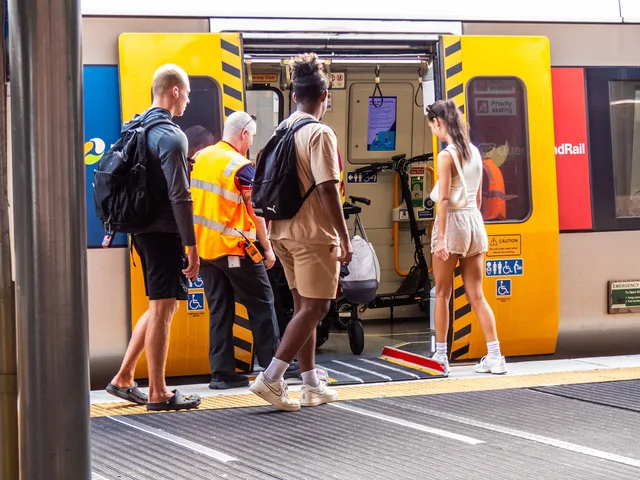
Newcomers who have only flown expect gates, groups, and a boarding pass scan, but many rail stations work differently. Staff may announce a track late, check tickets on board instead of at the barrier, or direct passengers to specific cars by destination.
At a major terminal such as Chicago Union Station or New York Penn Station, staff often post the track 10 to 15 minutes before departure and point you to the car for your destination.
On some services seats are unreserved. Relaxed passengers already know which end of the platform their car stops at.
The practical response is to arrive early enough to listen. Twenty minutes is usually plenty at a staffed station and not enough at a large terminal on a holiday weekend.
Where to ask: the ticket counter or the platform staff at a staffed station, and the conductor once you are aboard.
What Amtrak lets you carry
There is no baggage carousel on most journeys and often no baggage car. What you bring, you carry, lift onto a rack, and watch. That freedom is one of the real advantages of the train, and it catches people out in two ways: they bring more than they can lift, and they leave something behind at the seat.
Amtrak allows two personal items and two carry-on bags per passenger on most trains. Personal items are typically capped at 14 by 11 by 7 inches and 25 pounds, and carry-on bags at 28 by 22 by 14 inches and 50 pounds.
Checked service, where a station offers it, adds two free checked bags, up to four in total, typically capped at 50 pounds each and 75 linear inches. Not every station handles checked bags, so the route page lists which do.
At the far end the same problem has a local answer, since cafes and shops near a station increasingly store bags for the gap between checkout and the train.
- Bring one bag you can lift over your head unaided, plus one small bag that never leaves your lap area.
- Label the inside of every bag, not just the outside tag.
- Photograph the contents of the main bag before you leave home.
- Do a seat sweep before standing up, every time.
If something is left behind on an air leg, TSA publishes lost and found contacts airport by airport. On a train the search runs through Amtrak Customer Relations, which needs the train number, the date and the car before it can look.
Anything left elsewhere in the terminal belongs to the airport instead, and rail operators run their own systems.
Delay etiquette and who to ask
On a train, information reaches you through the conductor and the operator's own channels. There is no independent authority standing by at the platform. If the delay threatens a connection, tell staff early rather than at the moment you miss it; a rebooking arranged in advance is calmer than one arranged in a concourse.
Amtrak handles delay compensation case by case. The outcome depends on your fare and on what caused the delay. Weather and freight congestion usually bring nothing, while a mechanical fault on Amtrak's side is treated differently.
Complaints follow the same logic. Send a rail complaint to Amtrak Customer Relations with the train number, date and booking reference. For a regulatory issue, the Surface Transportation Board or your state rail authority is the right desk.
The FAA maintains a public page on where to report travel problems, which routes aviation complaints about service, refunds and discrimination to the Department of Transportation rather than to the FAA itself. Rail complaints have their own path, and the general lesson holds: send it to the right desk or it goes nowhere.
Small habits that help a first trip
- Expect scenery that is nothing like the marketing image for long stretches, and industrial for others; that is honest railroading, and the good views repay the plain ones.
- Book holiday weekends early; cars fill and seats go with them.
- Check the platform board again after you sit down; tracks can change late.
- Tell the conductor early if you plan to step off at a servicing stop.
- If you plan to photograph any of it on foot at the far end, weight rather than focal length decides the kit, as the car-free photographer's field list explains.
- Most of all, do not over-plan. The two-day template exists because a rail weekend rewards one anchor and a lot of slack, and the broader planning guide explains why the return leg deserves your caution.