Maintenance
Part of Four rail weekend scenarios: worked through from start to finish
4 things the rail weekend case studies teach
What the four scenarios would tell a first-time rail traveler: arrive earlier, pack lighter, book less, and sort the two or three items with rules attached.
What to take away
- Arrive earlier than feels sensible, at every stage. It is the advice all four scenarios converge on.
- Book less than you want to. One anchor per day is the sustainable maximum on a first trip.
- Two or three items in a typical bag have rules attached. Sort those before you leave.
- Confirm the return train on the operator's own site, for your actual date. Everything else is negotiable.
The advice all four agree on
The four scenarios point at the same handful of behaviors, and none of them are clever. That is the point: good first trips do not come from insider knowledge; they come from leaving margin where a beginner does not yet know margin is needed.
That margin has a shape. the weekend rebuilt from these four scenarios puts it in a later Friday, one Saturday anchor and an empty Sunday.
First-Trip Rail Weekend Checklist
- Arrive early at station and platform
- Carry one liftable bag
- Book one thing per day
- Write down return time as fixed
- Confirm time-sensitive details within a fortnight
Sort the items with rules attached
Almost every bag contains two or three things governed by a rule somebody wrote down. A first-time traveler finds them at the worst possible moment; an experienced one sorts them at home.
Blades are the classic case. TSA's sharp objects category sets out how knives, scissors, box cutters and similar items are handled, with most belonging in checked baggage and requiring sharp edges to be sheathed or securely wrapped so that baggage handlers are not injured. The pocket knife on a keyring is the item people forget.
Fire is the other. The FAA's matches page says one book or packet of safety matches may be carried in the cabin or on your person.
If the bag is gate-checked, remove them and keep them with you. Strike-anywhere matches are forbidden in both carry-on and checked baggage.
Rail travel imposes far less of this, but the habit of knowing what is in your bag is worth having on any mode. It also speeds up every other part of the trip, because a bag you have sorted is a bag you can find things in on a moving train.
The third category is anything powered. Chargers, power banks and camera batteries have rules on an air leg but none on a train. Keep them together in one pouch that stays with you, not scattered in a suitcase.
The rest of a first bag follows the same two-part shape: one liftable main bag plus that pouch, set out in a beginner's packing list for a rail weekend.
What each scenario would say
| Scenario | Its one sentence to a beginner |
|---|---|
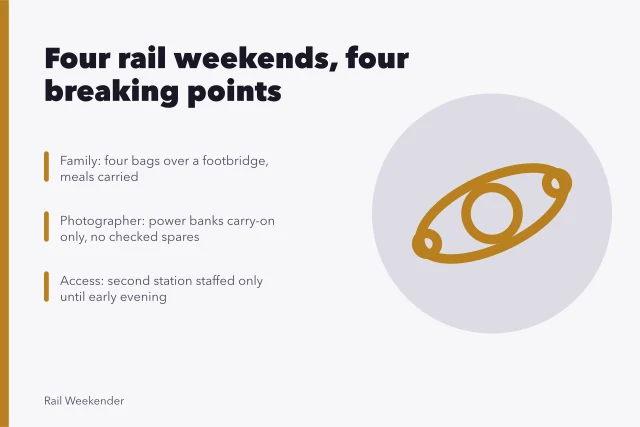
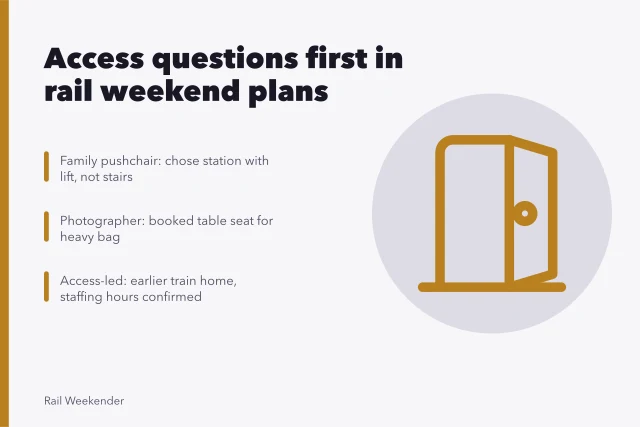
| Family | Carry the food, and choose the station with a lift |
| Photographer | Buy the seat, not the second lens |
| Access-led | Ask about staffing hours, not accessibility |
| Budget pair | Add up what you cannot get back before the last booking |
The one habit worth building
After each trip, write three lines: what happened, what you assumed, and what check would have caught it. Two or three trips of that produces a personal list better than any general article, including this one.
The full scenarios behind these tips are set out in the four worked planning scenarios, and the general beginner picture, written without the scenario framing, is in what first-time visitors miss about a rail weekend.