Costs
Part of Four rail weekend scenarios: worked through from start to finish
Where does the money actually go in four rail weekend budget scenarios?
How the four worked scenarios spend differently, which lines dominate each one, and the equipment decisions that quietly move a rail weekend budget.
What to take away
- Typical two-day totals$180 to $320 for a budget pair, $350 to $600 for one photographer, $400 to $700 for a family of four, $500 to $900 for the access-led trip.
- Equipment is a budget line, not a packing detail. Batteries, chargers and spares add up and constrain choices.
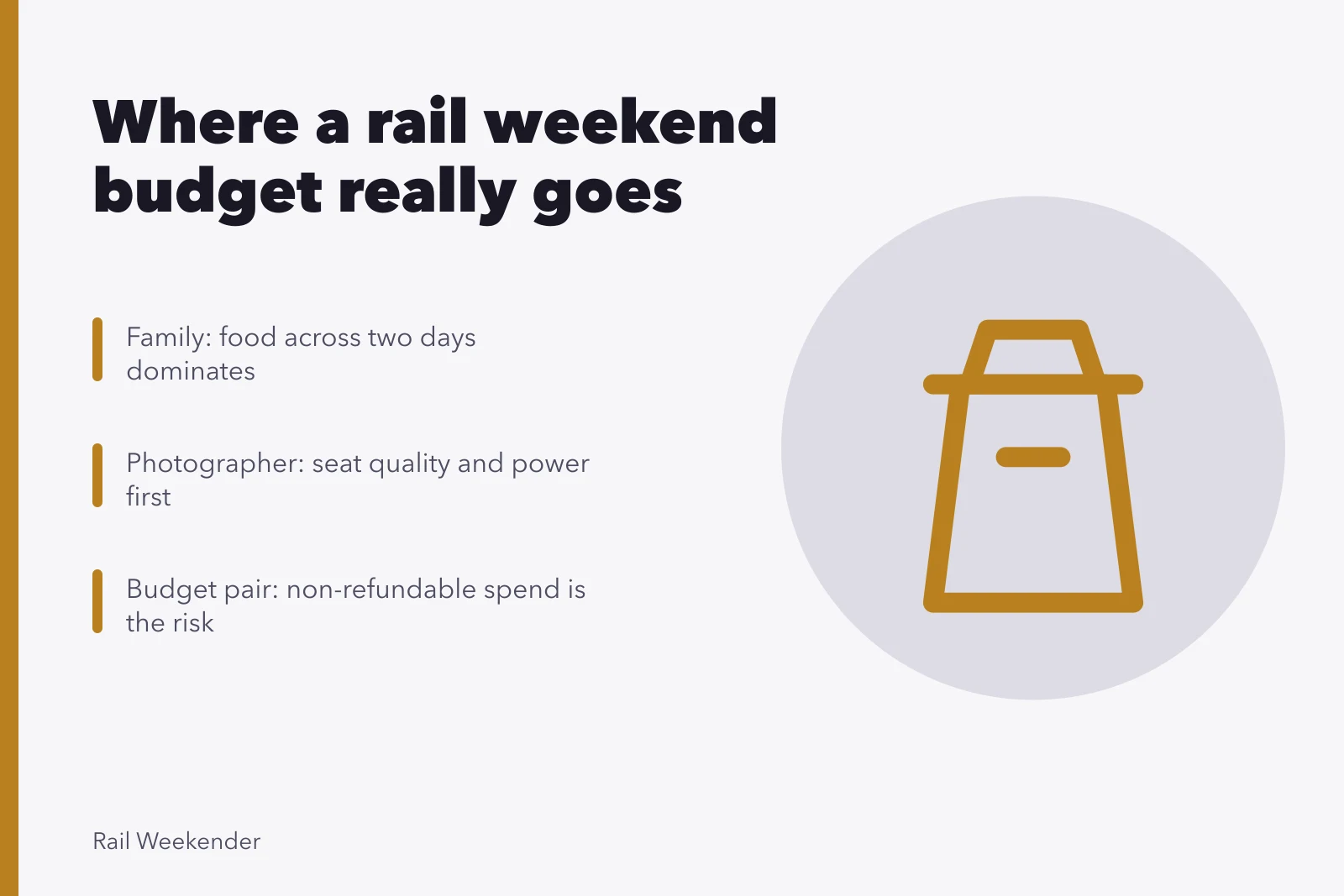
- The family scenario spends on food, the photographer on power, the access-led trip on transfers, the budget pair on rigidity.
- Attack the dominant line. Trimming the others is effort without effect.
Where each scenario's money goes
Dominant line
- Family
- Food across two days
- Photographer
- Seat quality and power
- Access-led
- Transfers and adapted rooms
- Budget pair
- Committed, non-refundable spend
Second line
- Family
- Lodging that sleeps four
- Photographer
- Two nights of lodging
- Access-led
- A larger contingency
- Budget pair
- Tickets
Typical two-day total
- Family
- $400 to $700 for four
- Photographer
- $350 to $600 for one
- Access-led
- $500 to $900 for two
- Budget pair
- $180 to $320 for two
Those are typical ranges for two travel days, before the long-distance fare. City, season and whether lodging is needed move them most.
The lesson is not that any of them overspend. Spending $100 less on the family trip means carrying breakfast and lunch for four. Spending $100 less on the photographer trip means giving up the seat and the power that justified the journey.
Where each scenario's money goes
Family
- Dominant line
- Food, two days
- Second line
- Lodging for four
- Advice misses
- Fare tips
Photographer
- Dominant line
- Seat quality, power
- Second line
- Two nights lodging
- Advice misses
- Cheap seats
Access-led
- Dominant line
- Transfers, adapted rooms
- Second line
- Larger contingency
- Advice misses
- Standard budgets
Budget pair
- Dominant line
- Non-refundable spend
- Second line
- Tickets
- Advice misses
- The risk
That contractual side has its own catalog of failures, from split tickets to the wrong fare class, in the rail weekend errors with a price attached.
The practical move is to build the budget, look at which single line is largest, and spend your effort there. Everything else is rounding.
Equipment is a budget line
Every scenario carries equipment, and equipment has costs beyond purchase: spares, chargers, and the occasional item that has to be bought at the destination because it could not travel.
Batteries are the clearest example. TSA's entry on lithium batteries above 100 watt hours bars spare cells of that size from checked baggage entirely. In the cabin they need airline approval, capped at two per person for cells between 101 and 160 watt hours.
Extended-life laptop batteries and larger professional audio and video packs sit in that band. A photographer who learns this at check-in surrenders the batteries or buys replacements at airport prices.
Heat-producing equipment has its own rules. The FAA's entry on battery-powered heat producing devices, covers items such as diving lamps and soldering tools. They are allowed only with airline approval and only when the battery, fuse or heating element is isolated so the device cannot switch itself on in a bag.
Both rule pages above were current as of publication. Both change, so check the linked pages before you pack.
The four cheapest structural changes
- Carry breakfast and one meal per travel day. This is the family scenario's biggest lever by a wide margin, and on regional lines there is often no catering to fall back on.
- Book lodging within the station radius. This is the access-led scenario's biggest lever.
- Buy the seat, not the second night. This is the photographer's.
- Cap the non-refundable exposure. This is the budget pair's, and it is a risk decision rather than a saving.
A family of four on a two-day trip typically spends $160 to $240 on bought meals. Carrying breakfast and one lunch each day cuts that to roughly $60 to $90, a saving of about $100 to $150. No other line on that trip comes close.
Dating the numbers
Write the date beside every figure, because fares, rates and parking charges all move. Run the totals through the six-line pricing method, then check the shape against the scenario closest to yours in the four worked planning scenarios.