Rules
Part of Four rail weekend scenarios: worked through from start to finish
How access needs held up across a set of rail weekend case studies
Accessible options in four rail weekend case studies: how each worked scenario handled access, the station that closed early, the equipment questions.
What to take away
- Access questions belong at the start of planning, because they constrain the route rather than decorate it.
- Every scenario had at least one access consideration, not only the one built around a wheelchair user.
- Confirm equipment handling in writing before travel. The answers are specific and the guesses are not.
- Where recovery options are narrow, choose the earlier train and the staffed station every time.
Access is not one scenario's problem
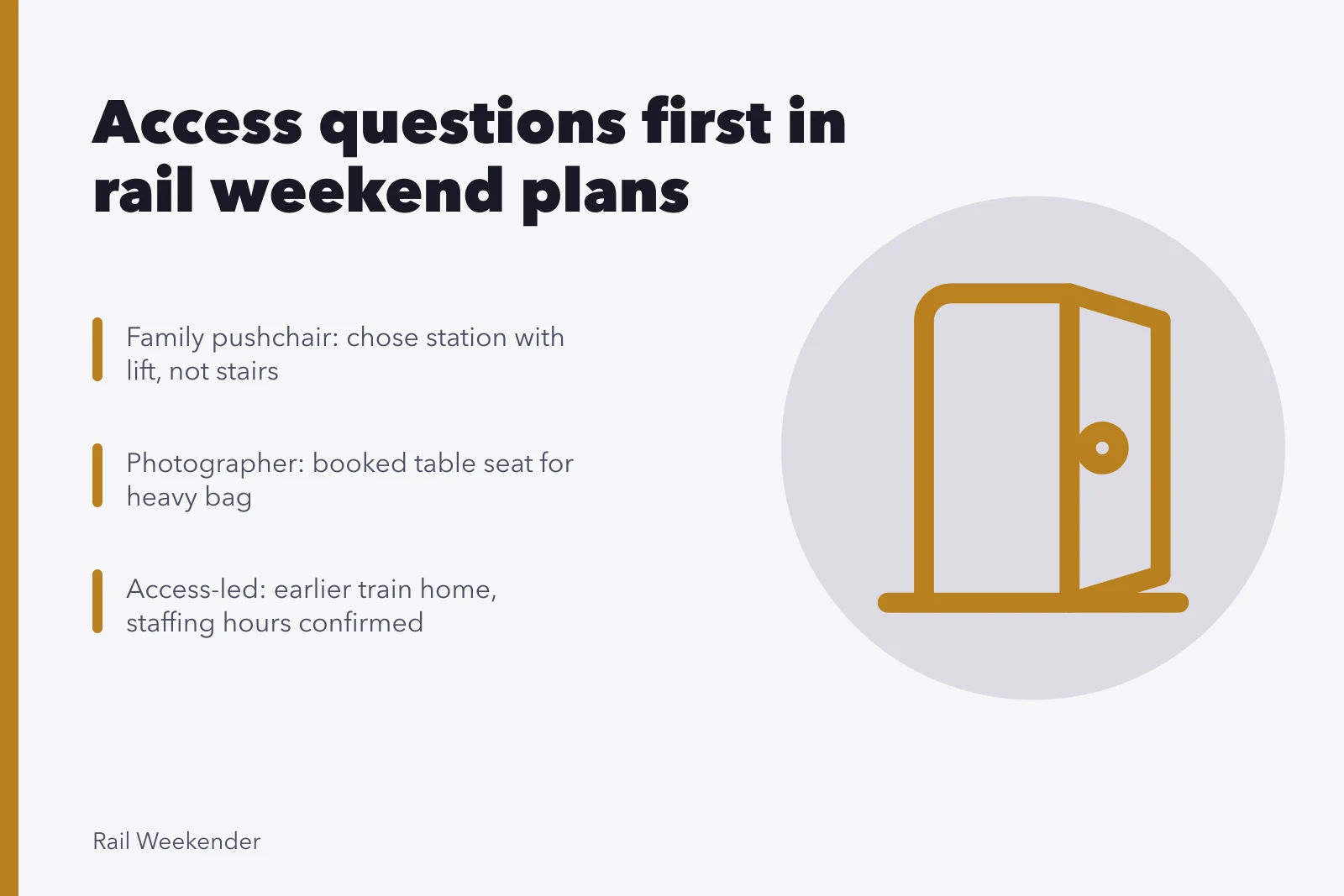
The family scenario has a pushchair, which needs the same step-free route as a wheelchair. The photographer carries equipment that cannot be left unattended. The budget pair includes somebody who cannot stand for long. Only one of the four was planned around access from the outset, and all four ran into it.
That is the argument for asking the access questions in every plan rather than only in the one that seems to need them. The questions cost nothing to ask, and the answers frequently improve a trip for everybody: a station with a lift is easier with a suitcase, and a platform with seating is better for anyone waiting forty minutes.
The failures that follow from not asking, starting with assuming a station is staffed, are set out in the access assumptions that ruin rail weekends.
What each scenario had to confirm
Access questions changed four plans
Scenario
- Family
- Step-free pushchair route
- Photographer
- Secure spot for heavy bag
- Access-led
- Return station staffing hours
- Budget pair
- Platform seating on long wait
Access question
- Family
- Lift station, not stairs
- Photographer
- Seat with a table
- Access-led
- Earlier train home
- Budget pair
- Changed the connection
Plan change
- Family
- Photographer
- Access-led
- Budget pair
Equipment questions have documented answers
Breathing equipment is the clearest case. TSA's entry on nebulizers and CPAP machines says the machine, facemask, and tubing may stay in the carrying case for X-ray screening.
A standard lane can still require the case out of the carry-on. An expedited lane leaves it where it is. Device liquids are exempt from the ordinary liquids limit in reasonable quantities. Anything holding a lithium battery stays in the cabin.
Compressed gas raises a different question. The FAA's entry on small compressed gas cylinders explains that cylinders and cartridges of nonflammable, nontoxic gas may be worn in mechanical limbs, with spares carried in either bag. TSA security rules otherwise prohibit compressed gas cylinders unless they are empty. Medical oxygen is treated under a separate entry.
Rail operators set their own procedures, which are usually simpler and less documented. The transferable habit is to ask in advance, name the specific device, and keep the written answer with the ticket. A dated email beats a remembered phone call every time somebody at a barrier disagrees with you.
What the access-led scenario did differently
It booked lodging first, since adapted rooms are scarce. It confirmed staffing hours by station and time, not whether a station was accessible. It chose a connection with double the minimum transfer.
It carried documentation, a spare charger and a list of equipment. Route knowledge came from a disability organization and a station volunteer, not a listings site. That is how all four scenarios found local expertise.
None of that is elaborate. It is the ordinary planning sequence with the access questions moved to the front, which is what the four worked planning scenarios show in practice and what the cost consequences in accessible options and the weekend budget describe in money.