Guides
Part of Scenic rail patterns worth copying: ridge runs, overnight legs, and more
5 details of rail packing list people miss
A rail packing list for a scenery-first weekend, with a seat kit, battery care, layers, easy food, and a bag you can manage from station to lodging.
What to take away
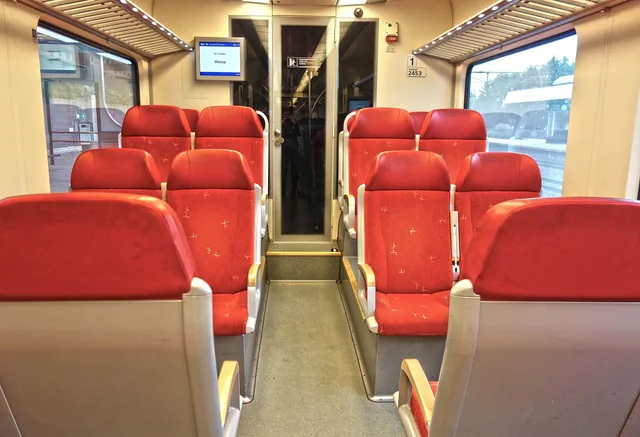
- This rail packing list starts with the seat, not the destination. Most of a scenery weekend is spent in one chair. Pack for the seat, not for the destination.
- Protect battery terminals, and check the operating carrier's battery rules before packing spares.
- Layers beat forecasts. Train-car temperature and platform temperature are different problems.
- Carry a refillable bottle and snacks that travel well.
- Keep one bag you can lift onto a rack, and test it with a walk before departure.
1. The seat kit
This is the bag that matters. It stays with you, holds what you use hourly, and means you never stand up to reach the rack. If photography is the point of the trip rather than a by-product, think about the lens, the hood, the shutter speed, and reflections when shooting through glass.
- Camera or phone, plus the cloth for cleaning the window.
- Power bank and the right cable, already connected.
- A refillable bottle, filled before boarding.
- Snacks that need no cutlery and make no smell.
- One warm layer, one thin layer, and something over your eyes for a nap.
- Paper map or downloaded route, because signal fails in exactly the scenic places.
2. Batteries, properly handled
Cameras on a scenic trip eat batteries, and spares travel with rules attached. TSA's dry batteries entry covers ordinary non-lithium sizes: AA, AAA, C, D and button cells. Nine-volts are also covered. These TSA allowances concern airport screening when a flight is part of the trip; for train travel, follow the operating carrier's rules. Amtrak's baggage policy sets the applicable baggage limits, so check it before packing.
For an air segment, retail packaging, a hard case or tape over terminals can protect batteries; lithium spares belong in cabin baggage. On a train, check the carrier's battery rules instead of assuming TSA or airline rules apply.
Powered mobility equipment has separate requirements. Before taking a device on Amtrak, check Amtrak's accessible travel guidance for current battery handling; an airline cabin rule should not be assumed to govern a train. The wheelchair options for train weekends page can help with accessible trip planning.
Protecting terminals is sensible on a train too, regardless of the carrier's specific battery rules. A shorted battery in a bag on a rack is a genuine problem, whatever mode you are on.
3. Layers for three kinds of weather
A scenery weekend usually contains a cold platform, an overheated train car and an outdoor hour somewhere in between. Pack for all three rather than for the forecast.
Job
- Base
- Comfort for hours of sitting
- Mid
- Warmth on platforms
- Shell
- Rain and wind at viewpoints
- Footwear
- Walking a town, standing on gravel
Notes
- Base
- Nothing that creases badly
- Mid
- Something that packs into the seat kit
- Shell
- Light enough that you actually carry it
- Footwear
- Broken in, not new
4. Water, food and the small things
Carry an empty bottle and fill it once you are through if a flight is involved: TSA lists an empty water bottle as permitted in both carry-on and checked bags. For a train-only trip, that airport screening rule does not govern; check the operating carrier if you need to confirm its onboard restrictions. Boarding with a full bottle saves money and queueing either way.
Beyond that: painkillers, a plug adapter if you are crossing regions, a pen for forms, and a spare bag for wet clothing. Leave behind the second camera body, the tripod, the third pair of shoes and the book you will not open. Every one of those is something you would carry up station stairs twice for no return.
5. Testing the pack
Lift the bag over your head; if you cannot, repack. Then walk fifteen minutes with everything, because that is the realistic distance from a station to lodging chosen the way cost planning for a scenic weekend suggests.
Adjust for the season, since a winter list is much heavier than a summer one. The seasonal differences actually drive the layer count.
Common questions
Do I need a tripod?
How much food should I carry?
For Amtrak, check the current baggage policy for the service you're taking and keep any cooler within its allowance. For a short trip, a soft-sided insulated bag is easier to manage and takes up less rack space.
What is the most commonly forgotten item? The charging cable that matches the power bank, followed by a warm layer for platforms.