Guides
Part of Twelve kinds of rail tour operator, and how to judge each one in 2027
Booking a rail tour: a grounded overview, updated for 2027
What to establish before paying a deposit on a rail tour: inclusions, group size, responsibility, medical and access handling, and photography permissions.
What to take away
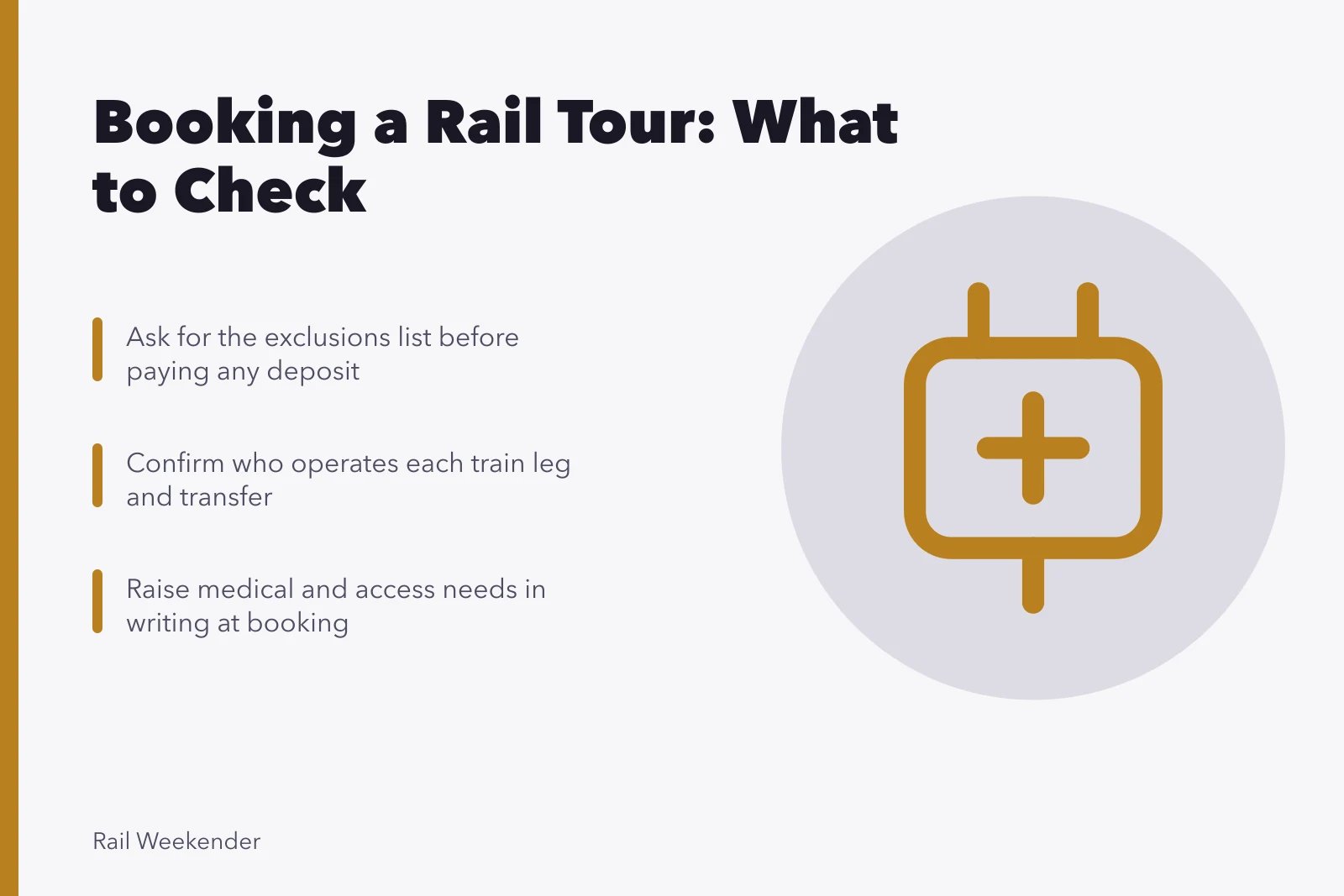
- Establish who is responsible for each leg before you pay. On multi-operator trips the answer is often nobody.
- Ask what is excluded, in a list. That list is where the price difference between two tours lives.
- Medical and access needs should be raised at booking, in writing, with specifics rather than labels.
- Photography, drones and filming have their own permissions. Ask what the tour actually holds.
Questions about what you are buying
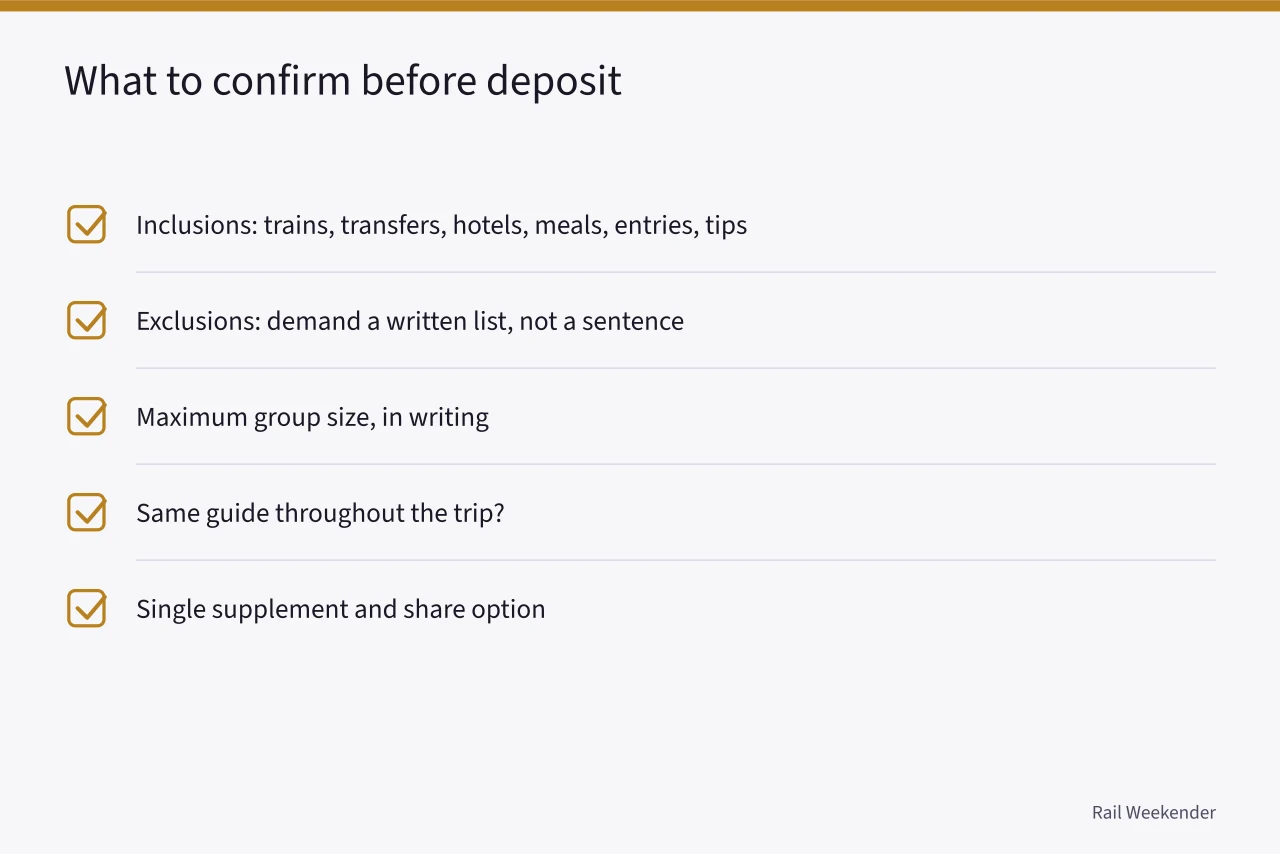
- Exactly what is included: trains, transfers, hotels, meals, entries, tips.
- Exactly what is excluded, as a list rather than a sentence.
- The maximum group size, in writing.
- Whether the guide is the same person throughout.
- The single supplement, and whether a share option exists.
Ask for the exclusions list first. Operators describe inclusions well and exclusions vaguely, and the difference between two tours is almost always sitting in the second list. The included hotel hides best of all, since distance from the meeting point rather than the star rating is what you are actually buying.
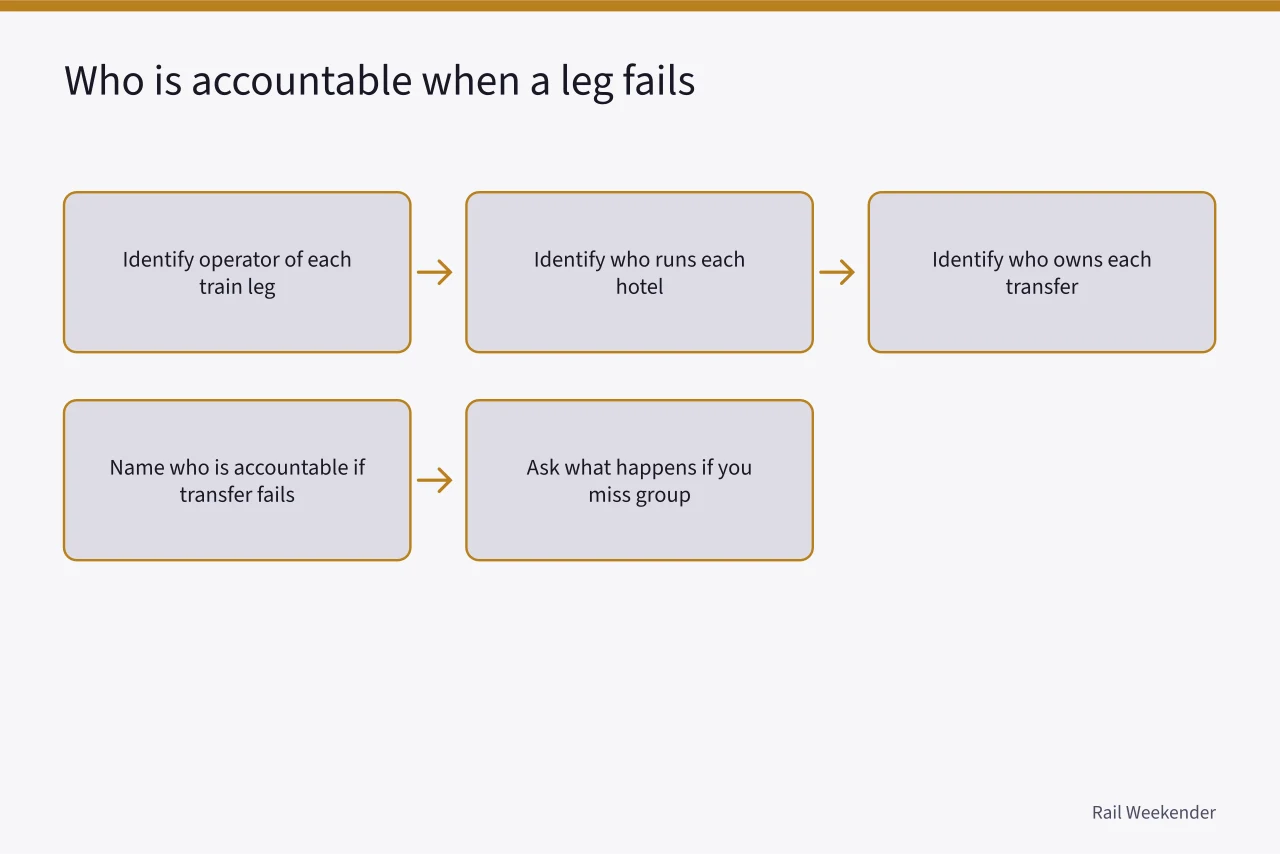
Questions about responsibility
Establish the chain: who operates each train leg, who runs the hotels, who is accountable if a transfer fails? On a trip combining several suppliers, the answer decides whether a problem is fixed or merely acknowledged.
The suppliers at the far end have their own version of that chain. The ones an operator books repeatedly are those that state capacity, lead time and terms in advance.
Ask what happens if you miss the group because of a delay on your own inbound journey. The answer tells you how the operator thinks about risk generally.
Questions about medical and access needs
Raise these at booking and put them in writing. Describe the barrier, not the diagnosis: how far you can walk, whether stairs are possible, what equipment you carry.
Equipment questions have documented answers elsewhere in travel, which is a useful model for how specific to be. TSA's entry on insulin pumps and glucose monitors tells a traveler to say that they have diabetes and are carrying supplies.
It requires the insulin itself to be clearly identified in whatever form it is dispensed. It adds that anybody who wants help getting through screening can ask for a passenger support specialist by name. An operator who answers your questions with that level of specificity has planned for you.
Questions about photography and drones
If you intend to fly a drone on the trip, ask whether the operator permits it, whether the properties visited permit it, and who obtains any permissions. If the operator advertises aerial footage, ask who flies it and under what certificate.
Carrying a drone at all needs a check before packing. The FAA's PackSafe entry on drones as dangerous goods notes that lithium batteries, fuel cells and parts of certain parachute systems can be classed as dangerous goods. It advises consulting the operating manual, the manufacturer and the airline before traveling.
| Ask | Why |
|---|---|
| Is drone use permitted on this itinerary? | Operators often prohibit it outright |
| Who obtains site permissions? | Airspace and property are separate questions |
| Are there filming restrictions on board? | Some operators restrict video in stations and on trains |
| Can I share images publicly? | Group privacy expectations vary |
Before you pay
Get the answers in writing, note the date, and check the cancelation deadline against when your own train tickets become non-refundable. The general version of these checks is in questions to ask when booking a train weekend, and the answers you get will also tell you which of the twelve operator types you are actually dealing with.
Common questions
How much deposit is normal? It varies widely. The refund policy matters far more than the amount.
Should I book through the operator or an agent? Either, so long as you know which one is responsible when something goes wrong.
What if the itinerary changes after booking? Ask now what right you have to a refund. Operators reserve the right to change; your remedy is the question.
Is insurance necessary? Add up the non-refundable exposure first, then decide. On multi-supplier trips it is usually higher than people expect.